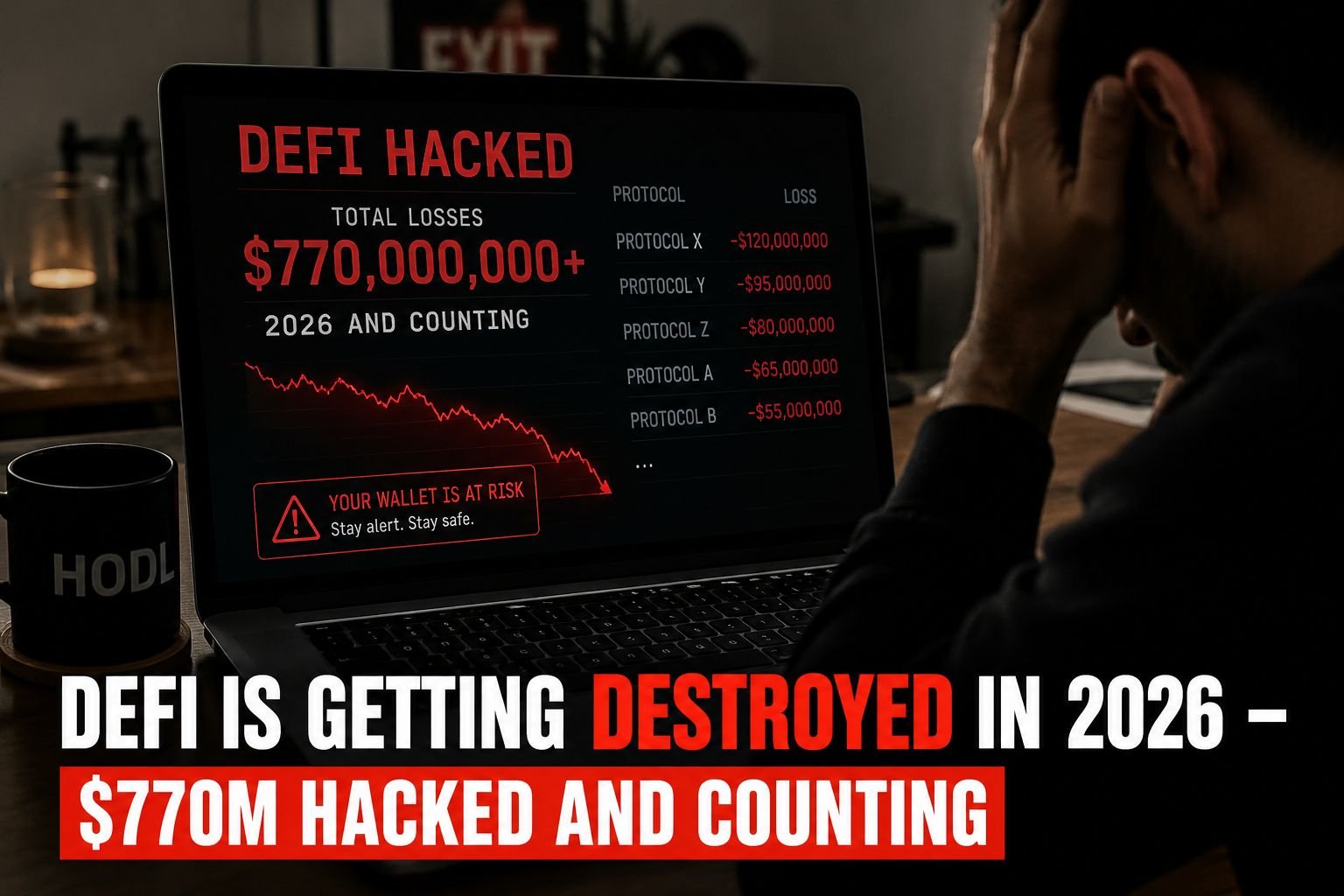
DeFi Is Getting Destroyed in 2026
If you have money sitting in a DeFi protocol right now, you need to read this, because DeFi Is Getting Destroyed in 2026 – $770M Hacked and Counting
In just the first four months of 2026, decentralized finance has been gutted by hackers to the tune of over $770 million. April alone shattered records, with nearly $650 million stolen across 30 separate exploits — the most hacking incidents ever recorded in a single month in crypto history. And the people behind the biggest attacks? North Korea.
This is not a normal rough patch. This is a structural crisis. Here is everything you need to know about the DeFi hack wave of 2026, what caused it, who is behind it, and how to protect yourself.
The Numbers: How Bad Is the 2026 DeFi Hack Crisis?
Let’s start with the cold, hard data.
According to blockchain security firms CertiK, TRM Labs, and Global Ledger, the DeFi sector has suffered the following losses in 2026 through April:
- Total losses: $770M+ across all incidents
- April 2026 alone: $641–$651M stolen — the highest monthly total since the $1.46 billion Bybit breach in February 2025
- Number of incidents in April: 28–30 separate exploits — the most ever recorded in a single month
- Year-over-year attack frequency: up 68% compared to the same period in 2025
- North Korea’s share: 76% of all 2026 hack losses came from just two DPRK-linked attacks
Two attacks dominated the carnage and together account for nearly 90% of April’s total losses: the Drift Protocol hack and the KelpDAO exploit.
The Drift Protocol Hack: $285 Million Drained in 12 Minutes
Date: April 1, 2026 | Loss: $285 million | Attack type: Social engineering + multisig compromise
Drift Protocol is a major Solana-based perpetuals DEX — one of the most established platforms on the network. On April 1, it lost $285 million in one of the most sophisticated attacks ever executed against a DeFi protocol.
Here is what makes this hack different from anything that came before: there was no smart contract bug. No code vulnerability was exploited. Instead, a North Korean hacking group spent six months building relationships — attending crypto conferences, deploying their own capital to appear legitimate, and slowly earning the trust of Drift’s core contributors while pretending to be a quantitative trading firm.
Once inside, the attackers pre-signed hidden authorizations (durable nonces) that gave them essentially blank check withdrawal rights over the protocol. When the moment came, they deposited hundreds of millions in worthless CVT tokens as fake collateral, exploited oracle pricing that valued those tokens at $1.00, and used their pre-authorized withdrawal limits to drain $285 million in real assets — USDC, SOL, and ETH — in just 12 minutes. The funds were bridged to Ethereum before Drift’s team could react.
The lesson: Code audits cannot protect you from a state-backed hacking group that spends half a year infiltrating your team.
The KelpDAO Exploit: $293 Million Gone in Under 2 Hours
Date: April 18–19, 2026 | Loss: $292–$293 million | Attack type: Cross-chain bridge exploit
Seventeen days after Drift, KelpDAO became the single largest DeFi hack of 2026.
KelpDAO is a liquid restaking protocol. Users deposit staked ETH and receive a receipt token called rsETH, which circulates across more than 20 blockchain networks — including Arbitrum, Base, Linea, and Scroll — via a LayerZero-based bridge. That bridge turned out to be a ticking time bomb.
The vulnerability was a configuration flaw: KelpDAO’s LayerZero bridge was set up with a 1-of-1 verifier, meaning a single node was responsible for validating all cross-chain messages. Attackers compromised two of the RPC nodes serving as data sources for this validator and injected fraudulent messages pretending to come from KelpDAO’s legitimate bridge contracts. The protocol’s validation layer accepted the spoofed messages as authentic and released the funds.
The result: 116,500 rsETH tokens — approximately 18% of the token’s entire circulating supply — were minted without any real backing, worth $293 million. From first transaction to full fund consolidation: under 2 hours.
The aftermath was devastating. Over $8.4 billion in deposits left Aave within 48 hours of the exploit. Total DeFi TVL across all protocols dropped by more than $13 billion. Aave’s bad debt ballooned to an estimated $123–$230 million. rsETH’s price collapsed, and protocols including Aave, SparkLend, and Fluid were forced to freeze their rsETH markets.
Blockchain analytics firms Elliptic and Chainalysis both linked the KelpDAO exploit to Lazarus Group — North Korea’s elite cyber unit — based on post-theft fund movement patterns. The stolen funds were laundered through THORChain, which refuses to freeze or censor transfers even from known illicit actors.
North Korea: The Biggest Threat to Your Crypto in 2026
The scale of North Korean involvement in 2026’s DeFi crisis is genuinely alarming.
According to TRM Labs, DPRK-linked hacking operations were responsible for 76% of all crypto hack losses in 2026 through April — not because North Korea launched a massive wave of attacks, but because two operations ($285M Drift + $292M KelpDAO = $577M) simply dwarfed everything else.
North Korea’s total crypto theft since 2017 now exceeds $6 billion. Their market share of annual crypto hacking has grown dramatically:
- 2020–2021: Under 10%
- 2022: 22%
- 2023: 37%
- 2024: 39%
- 2025: 64% (driven by the $1.46B Bybit hack)
- 2026 (through April): 76%
TRM Labs analysts note that North Korean hackers appear to be using AI tools to enhance reconnaissance and social engineering — making their attacks more targeted, more patient, and harder to detect than ever before.
Their go-to laundering route? THORChain. The cross-chain protocol processed the majority of stolen proceeds from both the 2025 Bybit breach and the 2026 KelpDAO hack, converting hundreds of millions in stolen ETH into Bitcoin with no operator willing to freeze transfers.
Other Major DeFi Hacks of 2026 (January–April)
Beyond Drift and KelpDAO, 2026 has seen a relentless stream of smaller but significant attacks:
Step Finance — January 31: $27–40 million stolen via phishing attack that compromised an executive’s device. Attackers used stolen private keys to drain 261,854 SOL from the protocol’s multisig. Step Finance shut down entirely following the incident.
Truebit — January 8: $26.4 million lost to an integer overflow flaw in the protocol’s smart contracts.
Resolv Labs — Early 2026: Over $20 million lost due to a cloud infrastructure key compromise.
Rhea Finance — April: $18.4 million drained from the lending protocol.
Grinex — April 15: $13.7–$19.4 million stolen from this Russia-linked exchange across 54 wallets. The exchange halted operations and blamed Western intelligence agencies, though Chainalysis suggested the incident may have been an exit scam.
CoW Swap — April 14: $1.2 million lost in a domain hijacking attack. Attackers impersonated company staff, hijacked the domain, and redirected users to a fake site.
Wasabi Protocol — April 30: $4.55 million drained after attackers compromised the deployer admin key and upgraded vault contracts on Ethereum and Base to malicious versions.
Why Is DeFi So Vulnerable Right Now?
Several converging factors explain the 2026 hack epidemic:
1. Cross-chain bridges remain the weakest link. The KelpDAO exploit is part of a long, painful history of bridge failures — Ronin, Wormhole, Nomad, and now KelpDAO have collectively cost the industry billions. Every time assets move across chains, there is a new attack surface, and bridge security configurations are often left to individual protocol teams who may not fully understand the risks.
2. Social engineering has replaced code exploitation. The Drift hack required no bug. It required patience, trust, and infiltration. As smart contract code quality improves, attackers are moving upstream — targeting the humans who control the protocols rather than the code itself.
3. Rising TVL = rising incentives. More total value locked means bigger paydays for successful exploits. The math is simple: if you are a state-sponsored hacking group with essentially unlimited resources and no legal accountability, DeFi protocols are the most valuable targets on the planet.
4. Protocol interconnectedness creates contagion risk. When KelpDAO was exploited, the damage did not stay in KelpDAO. rsETH collapsed across 20+ networks, $8.4 billion fled Aave, and total DeFi TVL dropped $13 billion. One hack now triggers ecosystem-wide panic in a way that was not possible in earlier cycles.
5. Attack frequency is accelerating. DeFi recorded 47 separate incidents in the first four and a half months of 2026 — a 68% year-over-year increase compared to the same period in 2025. The attackers are not slowing down.
Is There Any Good News?
Believe it or not, yes.
Recovery funds are emerging. In the aftermath of Drift and KelpDAO, the industry mobilized quickly. Tether pledged $127.5 million to support Drift’s recovery plan. DeFi United — a coalition led by Aave, Lido, and other major protocols — organized to restore rsETH’s backing after the KelpDAO attack.
Protocol freezes worked. For the first time at scale, coordinated cross-protocol freezes helped limit contagion. Aave, SparkLend, and Fluid froze rsETH markets within hours of the KelpDAO exploit, preventing additional cascading losses.
Institutional capital is demanding better security. Goldman Sachs’ $108 million Solana ETF position in April 2026 signals that institutional money wants exposure to DeFi — but that money will demand security standards far beyond what currently exists. Market pressure is building for real security upgrades.
How to Protect Your DeFi Portfolio Right Now
Given the current threat landscape, here are practical steps every DeFi participant should take:
1. Reduce bridge exposure. Cross-chain bridges are the primary attack vector in 2026. If your strategy requires heavy bridge usage, consider whether the yield justifies the risk. Native-chain positions are significantly safer.
2. Diversify across protocols. Do not concentrate all positions in a single protocol. The KelpDAO exploit created massive forced liquidations for users who had no connection to KelpDAO but were holding rsETH as collateral elsewhere.
3. Monitor protocol governance changes. The Drift hack involved removing a critical timelock from the protocol. Governance changes — especially ones that reduce security measures — should be a red flag. Follow your protocols’ governance forums.
4. Use hardware wallets. Private key compromises drove several 2026 hacks. Hardware wallets remove the most common attack vector from the equation entirely.
5. Check bridge verifier configurations. Before using any cross-chain protocol, check whether its bridge uses a multi-verifier setup. A 1-of-1 verifier (like KelpDAO’s) is a single point of failure that should be a dealbreaker.
6. Watch for unusual operational changes at protocols. The Drift attackers spent months earning trust before striking. Sudden team changes, new partnerships with unknown trading firms, or unusual parameter changes in a protocol you use should prompt caution.
Frequently Asked Questions
How much has been stolen from DeFi in 2026? Over $770 million in total losses through April 2026, with $641–$651 million of that coming in April alone — the most-hacked month in crypto history by incident count.
Who hacked Drift Protocol? North Korean-affiliated hackers, likely Lazarus Group, are suspected in the $285 million Drift Protocol exploit on April 1, 2026. The attack involved a months-long social engineering campaign to gain unauthorized access to the protocol’s multisig.
Who hacked KelpDAO? The $293 million KelpDAO exploit on April 18, 2026 has been linked to Lazarus Group by Elliptic and Chainalysis based on post-theft fund movement patterns. The attack exploited a single-verifier flaw in KelpDAO’s LayerZero bridge.
Is North Korea really behind these crypto hacks? Yes. TRM Labs estimates North Korea’s hacking operations (primarily Lazarus Group) were responsible for 76% of all crypto hack losses in 2026 through April. North Korea uses stolen cryptocurrency to fund its weapons programs, bypassing international sanctions.
What happened to DeFi TVL after the KelpDAO hack? Within 48 hours of the KelpDAO exploit, over $8.4 billion in deposits left Aave, and total DeFi TVL across all protocols dropped by more than $13 billion.
Are DeFi hacks getting worse in 2026? Yes. Attack frequency is up 68% year-over-year compared to the same period in 2025, and total losses are on pace to rival or exceed the worst years in DeFi history.
DeFi Is Getting Destroyed in 2026? Final Takeaway
The 2026 DeFi hack crisis is not a glitch. It is a symptom of an industry that scaled faster than its security infrastructure could support — and that made itself a target for the most sophisticated state-sponsored cybercriminals on the planet.
The protocols that survive this era will be the ones that treat security as a first-class product feature rather than an afterthought. For investors, the message is equally clear: in DeFi in 2026, the yield is real, but so is the risk. Know where your money is, understand the bridge infrastructure it touches, and never put in more than you are prepared to lose overnight.
The hackers are patient. Be smarter.
Sources: TRM Labs, CertiK, Global Ledger, Elliptic, Chainalysis, CryptoTimes, CryptoPotato, TheStreet Crypto. Last updated May 2026.